Climate change and energy transition

BUSINESS PRINCIPLE:Environment |
We have a systematic approach to environmental management in order to achieve continuous performance improvement. To this end, we manage these matters as critical business activities, set standards and targets for improvement, and measure, appraise and report performance externally. We continually look for ways to reduce the environmental impact of our operations. |
CLIMATE CHANGE AND ENERGY TRANSITION
The KPO Green Strategy is in line with the KPO-365 Strategy’s objectives and the KPO Environmental Concept’s principles.
The KPO Green Strategy covers five (5) key areas: GHG reduction, power strategy, offsetting strategy, water management and waste management.
- GHG reduction
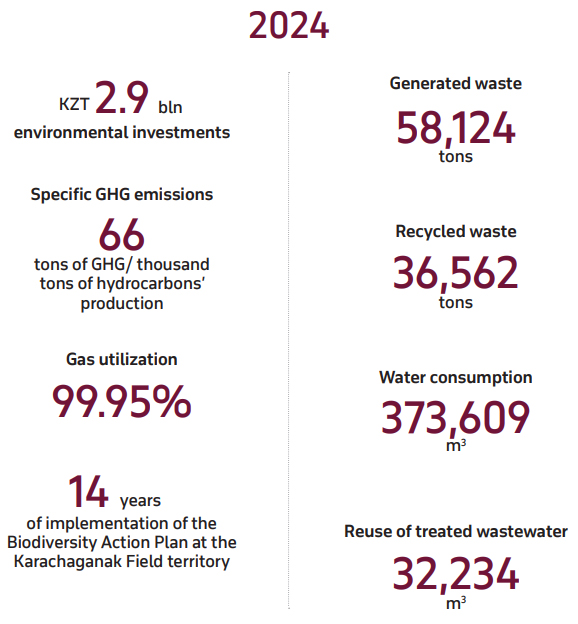
In 2024 KPO has undertaken a number of engineering and feasibility studies on solutions for GHG emission reduction measures. Renewable energy measures were explored, and a wind measurement campaign was completed, and a concept selection phase was initiated for waste heat recovery at the existing GTG and installation of heat recovery boilers at the new GTG as part of the Karachaganak Gas Plant scope. Besides, the work on identifying measures and improving energy efficiency in the company is also ongoing. KPO actively improves its practices and implements modern advanced technologies to reduce methane emissions. Commitment to emissions reduction is integrated into business planning, production processes and reporting. In February 2024, KPO joined the OGMP-2.0 initiative having prepared the Multi-Year Methane Emissions Reduction Plan aligned with the UN Environment Programme. This initiative helps companies monitor and prioritize actions to reduce methane emissions. The maximum annual methane emissions by 2029 are set at 0.05 tonnes of methane per thousand tonnes of produced hydrocarbons. - Power strategy
The main objective of the Power strategy is to ensure stable electricity supply that meets current and future KPO requirements as well as export obligations under the FPSA, considering the need to reduce greenhouse gas emissions, comply with regulations and implement the best available technologies. Intensive work continues to make final decisions on projects included in the KPO Power strategy. - Offset strategy
Carbon offset projects play an essential role in the decarbonization process in the medium and long-term perspectives as other solutions gain momentum. Through the offset strategy, KPO intends to compensate the shortfall in GHG emission quotes in addition to GHG reduction projects based on the engineering solutions. In 2023–2024, the feasibility of offset projects in the West Kazakhstan Oblast was assessed, and potential opportunities in sustainable agriculture, i.e. improved pasture management and the use of zero tillage in agriculture, were identified. - Water Management
Considering global and local water security risks, KPO aims to improve the efficiency of water resources utilisation by increasing the use of recycled water for technical needs of production facilities, introducing water-saving and digital technologies. The Aksai Sewage Treatment Plant Upgrade Project is assessed as one of the major alternative long-term sustainable sources of technical water. The project passed the concept selection stage and currently its further implementation depends on the decision of local authorities. - Waste Management
In 2024, a number of studies were conducted to find alternatives to upgrade the company’s existing waste treatment facilities, reduce waste generation, and increase recycling and reuse through the implementation of advanced technologies and sustainable waste management. These activities will continue in 2025.
/ GRI 3-3 /
Climate change is emerging as one of today’s key global challenges, requiring a responsible approach from the business community. For KPO, climate action, sustainable development, and adherence to ESG principles are central to our operations. Our commitment to achieving carbon neutrality reflects our dedication to minimizing environmental impacts, ensuring long-term sustainability, and contributing to global climate protection efforts.
A significant milestone was the adoption in 2023 of Kazakhstan’s National Carbon Neutrality Strategy by 2060, which outlines clear objectives and mechanisms for decarbonizing the country’s economy. KPO actively integrates these strategic goals into corporate processes and planning, guided by our responsibility towards society and the environment.