Occupational safety and health
BUSINESS PRINCIPLE::HSE |
We have a systematic approach to health, safety, security management in order to achieve continuous performance improvement. |
Pic. 9. Basic principles of KPO Health Department activities
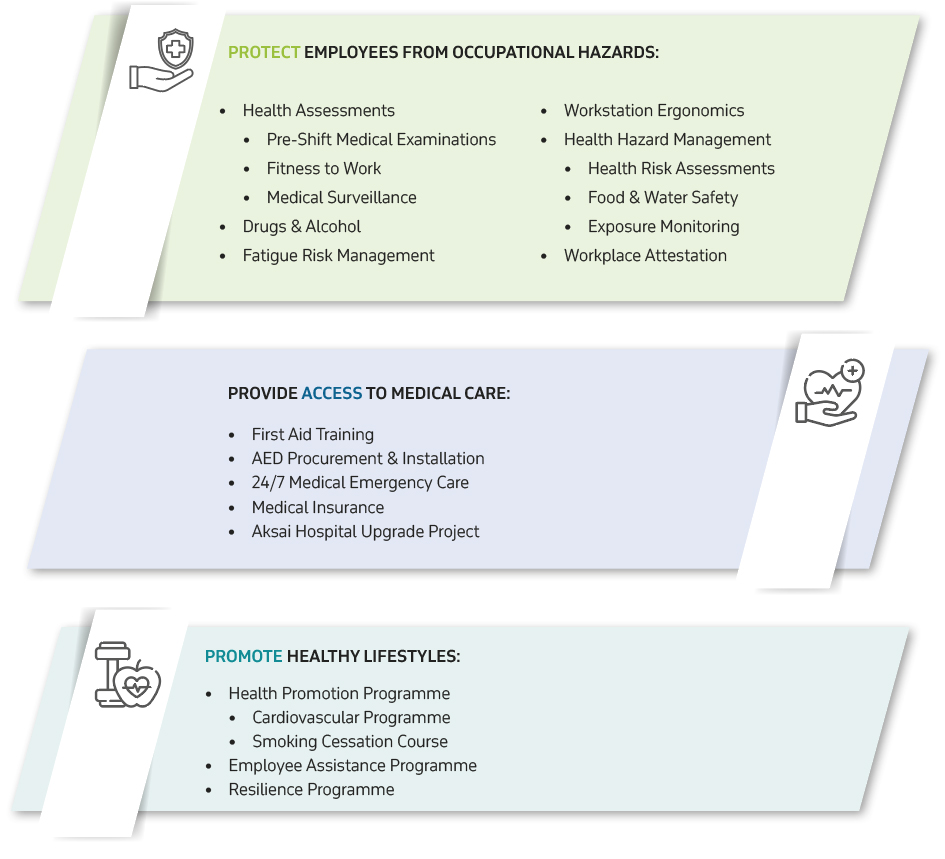
The results of the implemented targets that were set to minimize certain risks and the impact of workplace factors on the occupational health of employees are given below.
Tab. 14. Out targets in health protection / GRI 3-3, 414-2, SDG 3.4, 3.5, 3.8, 3.9, 8.8 /
|
Our 2024 targets |
Progress status |
Actions taken in 2024 |
Targets for 2025 |
|---|---|---|---|
|
ACCESS |
|||
|
In connection with the expansion of the KEP 1, to conduct an audit of the contractor’s medical sickbays on this project |
Completed |
Audit was conducted, related recommendations and actions were provided and closed |
Conduct the follow-up audit of BP’s medical sick bays |
|
Conduct AED Refresher Training for First Aiders |
Completed |
85 % of the total number of First Aiders at KPO have completed the refresh AED using training. |
|
|
Organise transition to a new medical insurance program, facilitating smooth communication and minimal disruption |
Completed |
The transition was implemented successfully. |
Collect and use feedback to ensure continuous quality of the medical insurance services. |
|
Improve First Aid level by training enough First Aiders amongst employees and by ensuring enough First Aid boxes and AED (Tier 1) |
In a progress |
Based on the Order of the Minister of Health of the RoK dated December 15, 2020, No. ҚР ДСМ-269/2020 “On the approval of the Rules for providing first aid by individuals without medical education, including those who have undergone appropriate training, and the Standard for providing first aid,” all Company employees working at hazardous production facilities have started undergoing first aid training. |
Train all Company employees working in hazardous conditions in first aid skills. |
|
Conduct assessment and prepare a plan to digitalize Doctors’ Medical Aid (Tier 2) |
In a progress |
Request were sent to KPO IT department |
To obtain Budget approval for digitalize Doctors’ Medical Aid (Tier 2) |
|
PROTECT |
|||
|
Continue participation in contractors’ welfare and HSE audits |
In progress |
The Sanitary Laboratory personnel participated in 11 audits. |
Continue participation in contractors’ welfare and HSE audits |
|
Further implement the Fatigue Risk Management Procedure to ensure it is applied both by the Company and contractors for managing fatigue risks |
In progress |
Roll-out of the Fatigue Risk Management Procedure continued. |
Run more seminars and “train-the-trainer” sessions for Business Partners to increase awareness of risks and controls among their personnel. |
|
Completed |
Training sessions were delivered. |
Continue implementation of the Legionella Management Procedure |
|
Implement the Workplace Attestation corrective action plans |
In progress |
Some actions are closed; others are in progress due to longer-term target dates. |
Follow up on the pending actions on the Workplace Attestation corrective action plans |
|
Completed |
The Policy on Prohibition of the Use of Alcohol in KPO has developed and implemented |
Continue implementation of the The Policy on Prohibition of the Use of Alcohol in KPO |
|
Provide “by request” radiation survey services |
In progress |
Radiological surveys of well tubing were conducted at requests from Well Operations Department |
|
|
Sanitary Compliance & Risk Based Monitoring Plan: to prioritize areas with higher sanitation risks and mitigate potential health hazards |
In progress |
Health Hazard Register has been updated. |
|
|
Сonduct six Health Risk Assessments as per the updated HRA Improvement Plan |
Completed |
Five HRAs were done. One HRA was rescheduled to 2025 due to the assessment unit (KEP1) not yet being commissioned. |
Conduct HRAs according to the plan |
|
Implement ‘Fitness To Work’ assurance measures for business partners (contractors) engaged KPO projects or activities. |
Completed |
The Plan was implemented; 99.5 % BP workers had up-to-date FTW certificates. |
Random checks of continuous compliance |
|
PROMOTE |
|||
|
Continue supporting facilitators who run sessions, provide training to new volunteers |
In progress |
Although the overall activity went down, facilitators continued sessions. |
Continue providing training to volunteers and support for facilitators. |
|
Consider alternative ways to provide mental health support to employees |
In progress |
Request for EAP program for KPO employees at the stage of raising |
Follow up with the raised request on the EAP program |
|
Implement 2024 Health Promotion Plan, including:
|
Completed |
Both Biometric Assessment and Nutrition Program were a great success. |
Continue Biometric Program |
Improving the quality of Emergency care / GRI 3-3, 403-3 /
Medical Support Section provide round-the-clock medical emergency response in the Karachaganak field and in Aksai offices. Apart from emergency calls, doctors and feldshers of the five sick bays provide outpatient care to patients, carry out pre-shift, pre-trip and post-trip medical examination, undertake health communication activities at industrial facilities, conduct regular sessions and exercises with personnel involved in the general emergency response process.
Tab. 15. Healthcare deliverables in 2022–2024
|
Medical support indicators |
2024 |
2023 |
2022 |
|---|---|---|---|
|
Number patients who admitted to clinics |
1,666 |
1,814 |
2,092 |
|
Number of emergency calls |
101 |
102 |
121 |
|
Number of patients delivered to medical facilities |
53 |
83 |
105 |
|
Number of sessions and exercises |
372 |
311 |
276 |
|
Number of first-aid trained employees |
394 |
364 |
330 |
|
Pre-shift medical examination (drivers / operators / electricians) |
2024 |
2023 |
2022 |
|
Examinations |
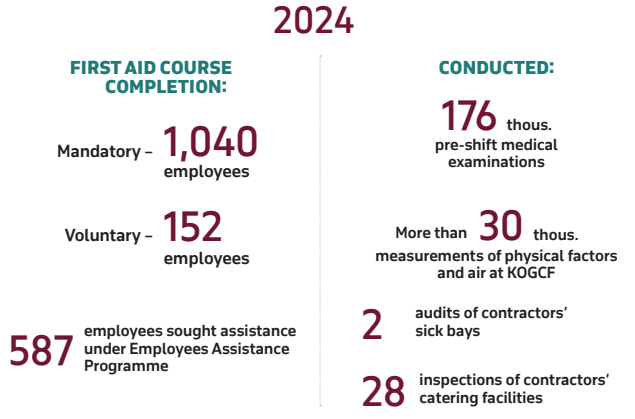
176,471 |
178,923 |
148,594 |
|
Number of “unfitness to work” cases |
160 |
162 |
191 |
|
Random alcohol tests SDG 3.5 |
4,163 |
1,105 |
1,688 |
|
Positive random alcohol test results |
0 |
1 |
0 |
Emergency Capability Upgrade Project in Aksai Hospital / GRI 3-3, 203-1, SDG 3.8, 9.1, 9.4 /
The 5-year Aksai Hospital Upgrade Project, initiated in January 2020, has significantly bolstered the hospital’s capabilities in medical emergency and intensive care. This progress is evident through improvements in key performance indicators within the hospital.
Acknowledging the substantial advancements made in emergency and intensive care capabilities from 2020 to present, and in response to requests from the WKO Akimat, regional health authority, and the Aksai district hospital, in 2023 the project was temporarily halted to refocus efforts on enhancing obstetrics, gynaecology, and paediatric neonatology services—a critical priority for stakeholders.
Preparatory activities for resuming the project in 2024 are underway, with the aim of delivering the Aksai Hospital Upgrade Project in time and within the approved budget.
In June 2024, the project resumed its activities, but with an emphasis and strengthening of the field of obstetrics, pediatrics and neonatology. For 6 months, the professional medical personnel of the contractor – University Medical Centre (UMC) worked at the Aksai Central District Hospital, conducted practical trainings at the workplace for the medical personnel of the Central District Hospital, provided seminars and lectures. During the project’s activities, the key, practicing personnel/ doctors of the Aksai Central District Hospital underwent training at the Medical Holding in Astana. In December 2024, according to the set deadlines and plans, the project was successfully completed.
Disease control amongst employees / GRI 403-3, 403-6, SDG 3.5, 3.8 /
Medical insurance
KPO employees and their families are provided with medical insurance that covers medical services in addition to those available through guaranteed free health care and mandatory RoK social medical insurance.
In 2024, a new medical insurance program was launched. It was designed to improve the service quality by having two providers compete for customers. Despite the initial difficulties, the transition went on well.
At the time of the start of the new program, there were 9,382 insured employees and their family members.
Sick leave absence monitoring / GRI 403-3, 403-10 /
The sickness absence rate in 2024 continued a downward trend since the COVID-19 pandemic peak.
Graph 5. KPO personnel sick leave absence rate, 2020–2024
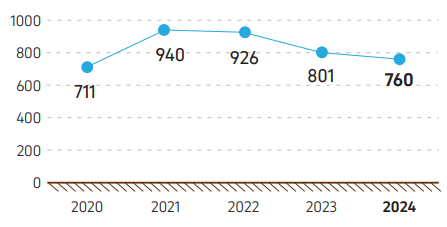
Note.: KPO uses the following method to calculate the sick leave absence rate:
- Sick leave absence rate = actual number of days lost due to absence from work (due to illness) x 100 / total number of employees. There is no information about the days of absence from the workplace for other reasons.
- KPO has adopted a methodology for calculating employees’ absence from workplace by the number of employees (not manhours), since this methodology is a regulatory requirement.
Occupational diseases / GRI 403-2, 403-3, 403-10 /
According to the Protocol of 2002 to the Occupational Safety and Health Convention, 1981 (No. 155), the term “occupational disease” covers any disease contracted as a result of an exposure to risk factors arising from work activity.
Occupational disease is a key indicator of the state of the Health Risk Management System of an organisation.
Good practice includes promoting a culture of risk prevention and well-being in the workplace, assessment and management of risks and proactive monitoring of ill-health.
Another way to reduce the occurrence of work-related diseases is by implementing workplace health promotion activities.
In 2024, no occupational diseases were registered among KPO employees.
Fitness for work / GRI 403-2, 403-3, 403-6 /
Fitness to work examinations are intended to determine if covered employees are physically and medically capable of performing the duties of the position efficiently and without posing a hazard to themselves or others.
In KPO, we ensure compliance with the relevant Republic of Kazakhstan regulations and also adapt the industry guidelines (IOGP/IPIECA).
In 2023 the Business Partners’ Fitness to Work Compliance Verification Plan was developed for the contract owners with the aim to improve control over BPs’ compliance with the regulatory FTW requirements. In 2024, the implementation of the Plan was completed.
|
Total Number of Active Contracts |
Total Number of Workers on these Contracts in KPO Field |
Number of up-to-date FTW certificates |
Total number of FTW Certificates requested for verification |
Total number of FTW Certificates received for verification |
|---|---|---|---|---|
|
175 |
15,986 |
15,909 (99.5 %) |
1,330 |
1,326 (99.6 %) |
OPERATIONAL CONTROL OF INDUSTRIAL FACILITIES / GRI 403-3, SDG 3.9, 8.8 /
KPO regularly monitors the Occupational Health and Hygiene at units and facilities. The below table shows the monitoring data for the last three years.
Tab. 16. Monitoring of workplace factors, 2020–2023
|
Workplace factors |
2024 |
2023 |
2022 |
|||
|---|---|---|---|---|---|---|
|
No. of measurements |
No. of non-conformances |
No. of measurements |
No. of non-conformances |
No. of measurements |
No. of non-conformances |
|
|
Noise |
486 |
124 |
492 |
122 |
420 |
91 |
|
Vibration |
84 |
29 |
84 |
29 |
75 |
16 |
|
Electromagnetic fields |
3,988 |
6 |
3,964 |
63 |
3,968 |
27 |
|
Electrostatic fields |
2,505 |
0 |
2,419 |
0 |
2,342 |
0 |
|
Lighting |
3,726 |
513 |
3,581 |
589 |
3,045 |
27 |
|
Microclimate |
7,044 |
668 |
6,474 |
790 |
6,258 |
575 |
|
Workplace air |
13,035 |
0 |
12,612 |
0 |
13,965 |
0 |
|
Total |
30,868 |
1,340 |
29,626 |
1,593 |
30,073 |
736 |
Non-compliance is reported to a respective unit management and corrective actions are developed, which are then tracked for closure by Synergi.
PROMOTION OF HEALTHY LIFESTYLE / GRI 3-3, 403-6, SDG 3.4, 3.8 /
Besides the usual World Health Organisation’s calendar-based activities and Employee Assistance Program, the Health Promotion Program in 2024 included a Biometrics Assessment Program and the Nutrition Program.
Табл. 17. Результаты программ по укреплению здоровья на 2024 г.
|
Programme Name |
Description |
Outcome |
|---|---|---|
|
Healthy Heart (Biometric Assessment) |
Building upon the successful Cardiovascular Risk Management Program the year before, a Biometrics Assessment Program was implemented in 2024. Medical Teams (doctor and feldshers) travelled to various KPO locations offering employees to assess their cardiovascular risk based on biometric measurements (height, weight, blood pressure and lipid profile test) followed by a consultation. |
775 employees participated (>20 % of the workforce). According to the consensus opinion of the participants, the Program was an overwhelming success. |
|
Eat Better (Healthy Nutrition) |
Healthy eating habits are the cornerstone of a healthy lifestyle. One of the country’s leading nutrition experts from the Kazakh National Academy of Nutrition was invited to deliver online training courses. The training was followed by a Cookbook Competition among KPO employees. The Academy expert jury judged the recipes. |
More than 100 employees joined the training. More than 30 recipes were submitted and a Cookbook published with the best recipes selected by the jury. |
|
Employee Assistance Programme |
The Employee Assistance Programme (EAP) was implemented at KPO in 2020 with the primary aim of supporting mental health and preventing harm to KPO employees. This includes addressing associated somatic diseases, self-harm, and mitigating the risk of suicides resulting from mental health challenges such as anxiety, depression, and panic attacks. The programme offers confidential consultations conducted by qualified third-party psychologists using multimedia, video, or face-to-face sessions, available 24/7 through a dedicated hotline. Additionally, group sessions and webinars are available as part of the programme. |
In 2024, a total of 587 employees sought assistance through various communication channels. |
/ GRI 3-3 /
Fitness for work is a broad concept as it deals with the relationship between a worker and his or her ability to perform their job duties safely and competently. The objective of fitness for work examinations is to identify physical and psychological limitations which may be incompatible, or cause particular problems, with performing a specific task or employment in a particular location.
For employees who have been assessed as ‘unfit’ or ‘fit with restrictions’, the Company provides job modification or transfers the worker to alternative work. This ensures that the employee is removed from a potentially harmful environment, but continues to be employed.
Equally important is the legal compliance with the Republic of Kazakhstan fitness for work requirements. This includes the Employer’s duties such as an arrangement of and payment for the medical examinations, categorisation of the workers in relation to their working conditions, suspending workers who have not timely attended a periodic medical check-up, taking action to improve employees’ health, reporting suspected occupational illness, etc.