Industrial relations / GRI 2-8, 2-24, 2-25, 2-26, 407-1, 409-1, 414-2, SDG 8.5, 8.7, 8.8 /
BUSINESS PRINCIPLE:Communication and engagement |
In our interactions with business partners, we seek to listen and respond to them honestly and responsibly |
BUSINESS PRINCIPLE:Communities |
We build productive, collaborative and trusting relationships with government, our shareholders, our business partners, the local communities where we work and with each other. |
To prevent contractor and/or subcontractor workers’ rights violations, workforce conditions are continuously monitored and analysed to detect and address potential situations, causes and/or conditions that caused deterioration of social conditions or infringement of the workers’ legitimate rights. Failure to provide adequate social conditions or comply with legal requirements by contractors and subcontractors may give rise to the above risks. In 2024, on average there were 20 k workers from 169 companies who provided services at the Karachaganak field; 54 companies were subject to monitoring of the Industrial Relations Section according to the criteria of clause 7.3 of the Industrial Relations Policy. Throughout the year the number of contractors’ workforce varied from 17 to 23 k as some projects commenced and completed at the KOGCF. / GRI 2-8, 414-2 /
When checking on violations of the contractor and subcontractor workers’ rights KPO strives to ensure that all concerns raised are given careful and timely consideration to ensure prompt resolution of the issues. Positions of all parties will be presented and reviewed with reasonable steps taken to protect and redress labour rights of the workers in line with the RoK laws, KPO Industrial Relations Policy, contractual obligations and the Declaration on Social Security Contribution Compliance, including:
- Continuously monitoring of social conditions provided by contractors and checking for full and timely payment of wages, provision of PPE, catering etc.;
- Organising forums and conferences on relevant topics (social welfare, discussions on challenges in the realm of industrial relations, sharing experience etc.);
- Interacting with and involving relevant labour authorities for grievance settlement and conducting awareness raising activities;
- Continuing introducing minimum salary into the contracts for provision of services at the rate of KZT 830 per hour after making of all compulsory payments. This is implemented as new contracts for provision/rendering of services are awarded;
- Monitoring and evaluating contractors’ wage level;
- Succession/transfer of skilled personnel from the existing contractor (whose contract expires) to a new one. This implicit practice helps maintain employment level in the region and maintain stable social environment during dissolution of the contract for provision of services.
In 2024, on average there were 20 k workers from 169 companies who provided services at the Karachaganak field; 54 companies were subject to monitoring of the Industrial Relations Section according to the criteria of clause 7.3 of the Industrial Relations Policy.
In maintaining stable social environment among contractors’ workforce, KPO continues to implement a general wage monthly allowance of KZT 60 k, after tax deductions. As of the end of 2024, the implementation of this programme has improved financial conditions of more than 15 thousand of contractor and subcontractor personnel. The goal of this approach is an equal attitude to all beneficiaries while focusing on the lower-paid workers.
In 2024, 43 contractors showed positive trend in adjusting salaries in 2024 to account for the 2023 inflation rate (indexation).
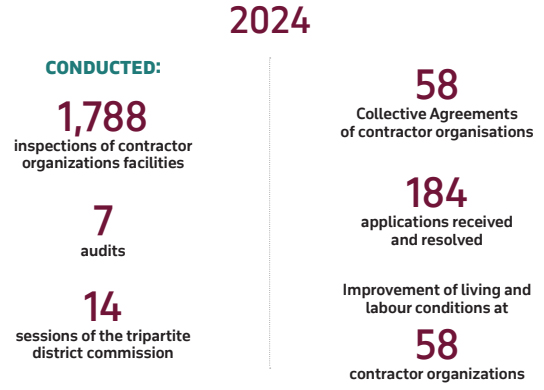
In 2024, Industrial Relations Section visited over 1,788 work sites and accommodation sites on a regular basis, including 7 joint audits with contract holders and 6 internal investigations in the industrial relations area. The internal audit findings were also shared with relevant authorities and law enforcement bodies for taking further actions.
In 2024, 43 contractors showed positive trend in adjusting salaries in 2024 to account for the 2023 inflation rate (indexation).
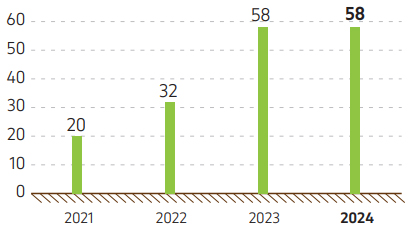
Throughout 2024, 14 tripartite district and oblast commission sessions were held to address risks that were identified in relation to contractors and subcontractors. As part of the monitoring, KPO keeps record of contractors’ collective agreements as this is a good sign that employees’ rights for freedom of association and collective bargaining are respected.
As of 2024, KPO contractors had 58 valid collective agreements. / GRI 407-1 /
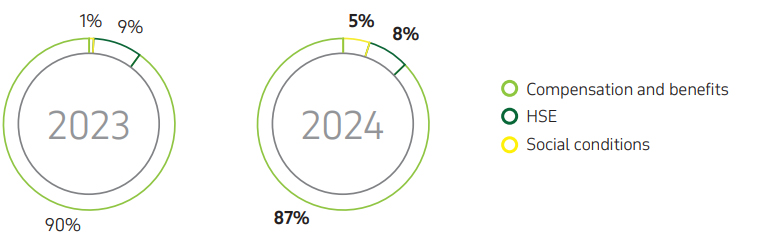
In total 184 complaints/concerns regarding different matters from contractors’ employees were received and addressed in 2024, of which 88 % dealt with compensation and benefits (the increase in claims is due to the introduction of KZT 60 k general allowance), 7 % dealt with HSE matters and 5 % were related to the provision of social conditions. / GRI 2-25, 2-26 /
Graph 18. Growing trend of KPO contractors’ collective agreements, 2021–2024
Apart from written complaints, Industrial Relations Section also handles up to 10 phone calls on average daily and holds meetings with contractors and subcontractors. 90 % of contractors’ complaints and concerns are directly communicated to KPO S&IRD.
41 contractors took steps to improve living and labour conditions as a result of the monitoring, audits and processing of the received complaints. It contributed positively to maintaining comfortable working environment. There were no cases of suppliers being terminated as a result of assessment of actual and potential negative social consequences. / GRI 414-2 /
Graph 19. Contractors’ applications to KPO, 2023–2024.
Compliance with the declared working and social conditions is monitored in an effort to prevent infringement/violation of the workers’ rights. Holistic approach is taken during this work: each complaint/concern is carefully evaluated with all detailed information provided to thoroughly check the facts relating to the complaints and/or concerns received.
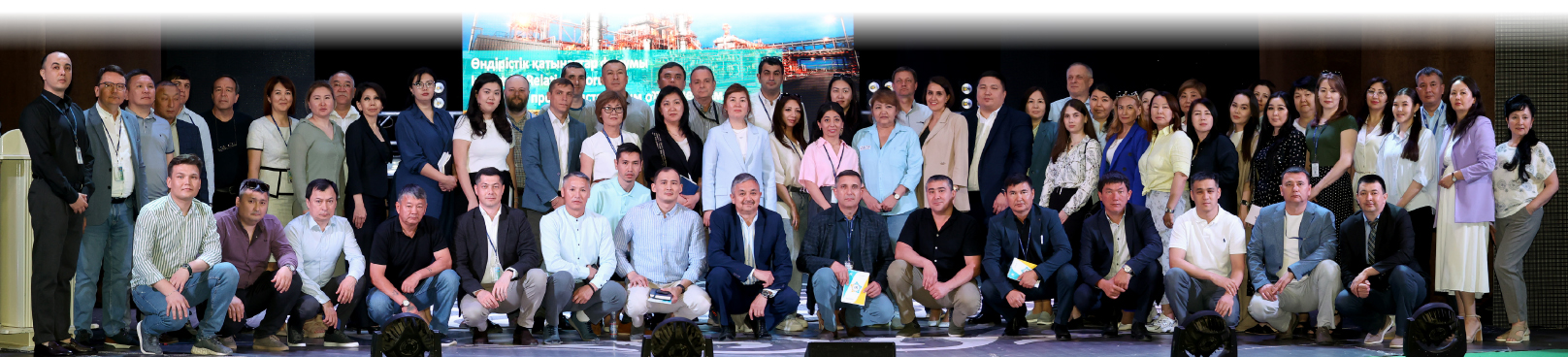
Starting from 2023 KPO has been hosting an annual Industrial Relations Forum. The Forum objective is to change approach to collaboration, develop and implement actions to maintain comfortable regional social environment and contractor / subcontractor workforce morale. Also, in 2024 Industrial Relations Section conducted sessions with Industrial Relations staff from business partners to identify potential industrial relations risks while searching for mutually beneficial risk reduction measures and sharing experience.
The negative conflict escalation trend decreased dramatically: during the reporting period there was one case (v. seven cases in 2023) of a pre-strike conflict which was promptly contained thereby avoiding escalation and heightening of tensions. Fast response helped prevent the conditions that could cause mass discontent.
Regular assessments of social environment carried out by KPO Industrial Relations Section helped identify key causes of mass discontent e.g. salary which does not meet workers’ expectations, lack of feedback from the company management.
/ GRI 3-3 /
In conducting its field operations and delivering its expansion projects KPO mainly relies on contractors as our key business partners. On average, there are 20,000+ contractor and subcontractor workforce engaged in the Karachaganak Project. Therefore, building a robust industrial relations management system by both KPO and its contractors and/or subcontractors is pivotal for achieving business objectives and production targets.
KPO strives to create and maintain adequate working conditions for its employees while monitoring the level of contractors’ working conditions in line with human rights provisions under the Constitution and the UN Convention on Human Rights