Water consumption and water disposal / GRI 303-1 /
Protection and rational use of water resources is an important and priority task facing both all mankind and our company. Water is the source of life and a valuable industrial raw material. The results of our work on minimizing the risks of the Company’s production impact on the use of water resources are presented below.
Water consumption / GRI 303-5 /
In 2024 total water consumption by Company was 373,609 m3, of which technical water – 281,218 m3, potable water – 92,391 m3.
Graph 26. Water withdrawal in KPO, 2022–2024/ GRI 303-3, SDG 6.4.1 (C060401) /
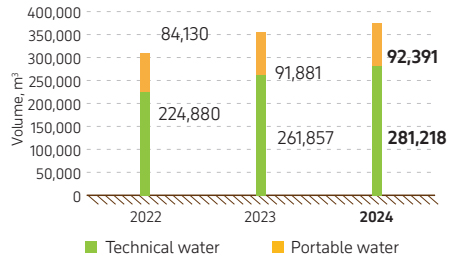
In 2024, KPO consumed water by 6.9 % more compared to 2023. Domestic water consumption was slightly higher than in 2023 which was due to the increase of well operations and construction of new facilities.
In 2024, the volume of water consumed for production processes and for technical needs made up 196,488 m3. / GRI 303-5 /
There is no seepage flow into the Konchubai Gully. The flow only occurs during the spring-time snow melt and rains. In 2021, the combination of prolonged dry periods and little snow floods observed in the region has led to a critical decrease in the water level in the holding pond No. 1 at the Konchubai gully. In this view, in the past last two years, KPO has been carrying out a number of activities allowing optimization of technical water consumption and increase the reuse of treated wastewater, rainwater, and melt water. Besides, after conducting experimental filtration studies at wells, produced water was sent to operational facilities for reuse for technical needs.
From January 2022 to March 2024, water was not taken from Konchubai Gully for technical purposes to avoid its damage.
During the 2024 spring-time snow melt, the Konchubai gully reached the design water level, which allowed to meet the demand for technical water for production needs at KPO facilities. / GRI 303-1, SDG 6.4 /
KPO Water supply sources / GRI 303-5 /
Prior to 2024, the main source of water supply for KPO production needs was a holding pond No.1 at the Konchubai gully. For the domestic needs, KPO used water from the Zharsuat water intake. Sources of water supply for domestic and process needs at the pumping station in Bolshoi Chagan is the Serebryakovskiy water intake, while the Atyrau pumping station is supplied from the Kigach water intake.
According to Atueduct Water Risk Atlas source of Water Resources Institute https://www.wri.org the Karachaganak Oil Gas Condensate Field is based in area with no water shortage.
If necessary, in 2025, alternative KOGCF water supply sources (Jurassic and Akchagylskiy horizons) can be used for technical needs. Permit documentation for the groundwater extraction is going to be completed this year prior to the water intake’s operation.
Technical water is used from Holding Pond No.1 of the Konchubai Gully, under the Special Water Use Permit issued by the Zhaiyk-Caspian Basin Inspectorate № KZ43VTE00079540 Series Kas. Zhayik (surface) dated 19.10.2021 (valid till 24.05.2025).
Treated domestic, rainwater and melt wastewater is reused for technical purposes, if the quality complies.
In 2024, the potable water was used for domestic needs of KPO facilities. By exception, due to the lack of alternative water sources, the potable water on Bolshoi Chagan’s Pumping Station is used for technical purposes to refill fire water tanks and ensure the fire safety.
On potable water usage for the Karachaganak Field facilities, KPO is the secondary user under contract with AksaiGasPromEnergo LLP, a supplier of potable water from Zharsuat water intake.
Table 38 shows KPO water consumption breakdown by source.
Tab. 38. KPO water consumption in 2022–2024, m3 / GRI 303-3, 303-5, SDG 6.4.1 (C060401) /
|
# |
Source |
Unit |
Water quality |
2024 |
2023 |
2022 |
|---|---|---|---|---|---|---|
|
1 |
Zharsuat water intake facility (household needs) |
KOGCF |
groundwater, potable |
91,119 |
90,257 |
82,404 |
|
2 |
Study of water holding pond #1 at Konchubay gully |
KOGCF |
surface water, technical |
277,606 |
206,140 |
14,130 |
|
3 |
Ground water from Akchagylsky aquifer, wells No. W-4, W-9 |
KOGCF |
ground, technical water |
– |
– |
4,967 |
|
4 |
Technical water from Holding Pond No. 2 |
KOGCF |
surface water, technical |
– |
50,920 |
172,450 |
|
5 |
Reuse of rainwater and groundwater after wells testing for technical needs of KOGCF |
KOGCF |
Reuse |
12,181 |
10,445 |
30,816 |
|
6 |
Serebryakovskiy water intake facility |
Bolshoi Chagan Pump Station (BCPS) |
groundwater, potable |
1,272 |
1,624 |
1,726 |
|
For household needs |
|
|
548 |
645 |
670 |
|
|
For production needs |
|
|
724 |
979 |
1,056 |
|
|
7 |
Kigach water intake facility |
Atyrau OPS |
surface water, technical |
3,612 |
4,797 |
2,517 |
|
for household needs |
|
|
864 |
776 |
749 |
|
|
for production needs |
|
|
2,748 |
4,021 |
1,768 |
TREATED WASTEWATER DISCHARGES / GRI 303-2, 303-4, SDG 6.3 /
KPO uses special man-made facilities for collecting treated household/domestic water and disposing industrial wastewater and storm runoffs, and these facilities prevent contaminants from entering the soil and groundwater as well as allow collecting the treated wastewater for their re-use for technical needs, thereby reducing the fresh water intake. Wastewater c
Tab. 39. Table 12 KPO wastewater collection facilities by types
|
Type of wastewater |
Treated domestic wastewater |
Industrial wastewater and storm runoffs |
Rainfall and snow melt wastewater |
|---|---|---|---|
|
Facility and location |
|
|
|
Produced water extracted with hydrocarbons and process wastewater are treated and injected into the deep-lying formations of the KOGCF Subsurface Wastewater Disposal Polygons Nos. 1 and 2. Wastewater injection is the international practice of disposing wastewater, avoiding the formation of salt-containing waste on the surface during the treatment. Due to the reliable water shutoff and soil properties, which are perfect for the injection of wastewater, the migration of wastewater into upper aquifers is ruled out.
In 2019, the Company has developed the Unified concept of options for the treatment of wastewater injected into the underground strata, alternative to the strip column at Unit-3. Two alternative options were suggested for consideration as most appropriate solution:
- Disposal of wastewater from Unit-3 to Unit-2 using the Unit-2 production water treatment system (the existing H2S strip column);
- Disposal of wastewater from Unit-3 to the existing 14” condensate pipeline to KPC.
Due to optimization of resources and maintaining compliance with the Rok requirements, the Company stopped project development on strip column installation at Unit-3 and from 2020 has continued development of the design project on the second alternative option of the wastewater treatment at
Unit-3 as defined by the Unified Concept Report.
In 2020, the project “Unit 3. Process Water Line Jump-Over of the KOGCF” was implemented, the aim of the project was to reduce the H2S concentration in the injected wastewater by re-routing process water from Unit-3 to KPC via the existing condensate pipelines. The project includes installation of a jump-over line to reroute produced water from Unit-3, which is currently supplied to Polygon 1 RP-1 and RP-3 wells, to KPC via the existing condensate pipelines transporting unstable condensate from Unit-2 and Unit-3. Water will be separated and further supplied to the KPC existing produced wastewater system.
According to the Rok legislation, the volumes of discharged wastewater and contaminants are estimated and justified in the Company project documentation and regulated by special permits. Wastewater generated as a result of the KPO economic and production activities is not discharged into the natural water bodies.
In the production process of hydrocarbons, the separated formation water is pumped down to the underground water horizons (polygons). In 2024, this volume has made up 712,600.45 m3. / GRI 303-3, 303-4 / This water volume includes the formation water, the water formed during the gas dewatering and the water after the caustic neutralization. Water taken from the Konchubai Gully for desalting of crude oil and for the the reverse osmosis is also injected into the polygons. In 2024, this water was 17,68 % of the total water injection.
Table 40 shows the KPO discharge volumes in 2022–2024 by wastewater types and receiving facilities.
Tab. 40. Total discharge volume and contaminants by wastewater type and receiving facility, 2022–2024, m3
|
Receiving facility |
Type of wastewater |
2024 |
2023 |
2022 |
|||
|---|---|---|---|---|---|---|---|
|
Discharge volume, m3 |
Amount of contaminants, tonnes |
Discharge volume, m3 |
Amount of contaminants, tonnes |
Discharge volume, m3 |
Amount of contaminants, tonnes |
||
|
Holding ponds |
Treated domestic wastewater |
20,603 |
10.024 |
27,484 |
15.20 |
42,412 |
29.44 |
|
Subsurface Wastewater Disposal Polygons |
Industrial wastewater, process and produced wastewater |
865,917 |
69,631 |
808,777 |
68,826 |
764,139 |
60,699 |
|
Terrain of Bolshoi Chagan OPS and Atyrau OPS |
Rainfall and snow melt wastewater |
3,450 |
0.996 |
4,501 |
2.33 |
3,168 |
1.81 |
|
Total discharge |
889,970 |
69,642 |
840,762 |
68,843 |
809,719 |
60,730 |
|
In 2024, the volume of discharged wastewater increased by 5.5 % as compared to 2023. Of which, in 2024, the volume of injected industrial wastewater increased by 6.6 % as compared to 2023. The increase in industrial wastewater in 2024 was due to the produced water growth in the hydrocarbons production. The volume of discharged treated domestic wastewater decreased by 25 % as compared to 2023 due to suspension of treated domestic wastewater discharge from the bio ponds of Trains A and B to the KCC holding ponds 1 and 2 to accumulate water for technical reasons.
In 2024, the discharge of contaminants amounted to 69,642 tonnes (which was 1.1 % more compared to 2023 – 68,843 tonnes). Only 0.01 tonnes were discharged over the limit. Insignificant excess volume of discharged pollutants was reported for domestic wastewater, discharged into the KCC Holding ponds No.2, namely the exceedance was on nitrite nitrogen. KPO controls the content of pollutants in wastewater. According to the Maximum Permissible Discharges (MPD) limits project for 2024, the composition of pollutants in discharges includes the following: suspended substances, ammonium nitrogen, nitrates, nitrites, BOD 20, BOD 5, petroleum products, sulphates, chlorides, iron, anionic surfactants, phosphates, COD, dry residue, pH value, sulfides, hydrogen sulphide, methanol, copper, zinc, aluminium. The Company made necessary payments for the generated contaminants discharges in 2024.
In general, wastewater injection has no effect on the environmental components such as soil, flora and fauna, as wastewater is injected into effectively isolated deep horizons with high-mineralized groundwater that is not used for domestic and potable, balneological, process needs, irrigation or livestock farming.
Reuse of treated wastewater and other water / GRI 303-3 (2016), SDG 6.3 /
In order to reduce fresh water intake, for such KOGCF technical needs as drilling, making drilling muds, watering of planted trees, dust suppression on roads and constructed sites and filling fire tanks KPO uses treated domestic, production storm wastewater and storm runoffs.
The wastewater is re-used at the Company facilities in line with the 2023–2028 Operating Procedure.
In 2024, the Company reused 32,234 m3 of treated wastewater for technical needs, mostly for making drilling mud. Table 41 shows the activities that utilize treated wastewater.
Tab. 41. Reuse of treated wastewater and groundwater in 2022–2024, m3
|
|
2024 |
2023 |
2022 |
|---|---|---|---|
|
The total re-used volume, including: |
32,234 |
56,467 |
75,452 |
|
For technical needs of KOGCF production facilities |
12,181 |
13,383 |
42,161 |
|
For drilling and drilling mud preparation |
10,087 |
26,095 |
18,509 |
|
For irrigation, hydro tests, and replenishing of fire tanks |
2,323 |
1,996 |
10,376 |
|
Dust suppression and irrigation |
7,643 |
14,993 |
4,406 |

Industrial wastewater management / GRI 303-2 /
The Karachaganak Oil and Gas Condensate Field facilities KPC, Unit-2, Unit-3 generates the industrial wastes associated with oil and gas processing, which are subsequently injected into the deep water-bearing horizons at Wastewater Disposal Polygons N1 and N.2.
According to the RoK legislation, the volumes of discharged effluents and contaminants are estimated and justified by the Company project documentation and regulated by special permits.
Tab. 42. Targets in managing effluents / GRI 3-3, SDG 6.3, 6.4 /
|
Our 2024 targets |
Target achievement status |
Actions taken in 2024 |
Targets for 2025 |
|---|---|---|---|
|
Postponed |
RP-7 workover performance is deferred to 2025. The reason of RP-7 workover deferral to 2025 is the equipment pending delivery. |
Carry out workover of well RP-7 in 2025 |
|
Completed |
The post-project analysis of design solutions implementation as part of Amendment 3 to the project for wastewater injection into the deep water-bearing horizons in terms of updating design parameters and EIA chapter was performed. The post-project analysis conclusion is published on the official eco-portal of CERC on 26 June 2024. |
– |
|
Q2 2025 |
|
To carry out KPC Process Water Treatment unit trial in segregated mode with the total injection rate up to 115 m3/h in order to verify that this mode is generally feasible. |
|
Completed |
|
|
|
Not completed |
An application for a Special Water Use Permit for Jurassic ground water reservoir production from wells J1 and J2 will be submitted after completion of wells drilling. |
|
|
Not completed |
The documents package has been prepared for Projects Value Assurance workshop required prior to taking a Final Investment Decision. Further works were suspended pending approval of the republican budget for the Aksai Wastewater Treatment Plant upgrade |
|
Managing produced and industrial effluent water is one of the key challenges faced by KPO in the Karachaganak field.
KPO’s industrial water management strategy consists of implementation of a portfolio of interconnected projects aimed at removal of production restrictions in terms of produced water handling as well as ensuring personnel safety, asset integrity and environmental compliance.
Waste water disposal at Polygons N1 and N.2 is performed in accordance with “Addendum No. 3 to the Project for injection of the Karachaganak industrial wastewater into deep water-bearing horizons on adjustment of the design parameters and Environment Impact Assessment (EIA) section”. In 2022 this document was agreed in accordance with the RoK regulations requirements by the Department of the Industrial Safety Committee as well as a positive conclusion on EIA section was received from the Committee for Environmental Regulation and Control.
In accordance with Addendum No. 3 to the Injection Project the design parameter, in terms of industrial wastewater injection volume at Polygon N2, was increased from 2023 until to the end of the Polygon operation in 2037 up to 1,100 thousand m3 per year, as well as the implementation of technical measures to increase the potential of the injection well stock through additional perforation of target and prospective injection intervals and hydraulic fracturing.
In 2024 in accordance with the requirements of the RoK Environmental Code and the “Rules for conducting of post-project analysis and forms of conclusion on post-project analysis results” for “Addendum No. 3 to the project for waste water injection into the deep water-bearing horizons on adjustment of design parameters and EIA section” the post-project analysis of design solutions implementation was performed and a Conclusion was developed by the author of the design project. This Conclusion was posted at the electronic portal of the Environmental Regulation and Control Committee to the RoK Ministry of Environment and Natural Resources.
Managing produced and industrial effluent water is one of the key challenges faced by KPO in the Karachaganak field.
Activities on upgrade of a caustic neutralisation unit have been in progress since 2022; major construction works have been completed by the end of 2024 and commissioning was being carried out; ready for start up is planned for the Q1 2025.
As part of the implementation of the design solution and in order to increase the perforation intervals in the Reservoir II, the workover of the well RP-7 planned in 2024 was deferred to 2025 due to equipment pending delivery.
Tab. 43. Industrial wastewater management projects, ongoing in 2024. / GRI 303-2 /
|
Project |
Business driver |
Note |
|---|---|---|
|
Upgrade of a caustic neutralisation unit |
Safe operations |
Implementation of the project will provide improvement of the caustic neutralization process. Automation of the process will allow to reduce the risks for personnel exposure to toxic agents. it is important to note, that the upgraded Caustic Neutralisation Unit project will be able to partly utilize the Reverse Osmosis water which otherwise would have been disposed. |
|
Upgrade of sand and guard filters |
Maintaining production level |
Upgrade of sand and guard filters will allow KPC to achieve water treatment capacity up to 115 m3/d. |
|
Technical Water Supply from the Aksai Wastewater Treatment Plant |
Maintaining production level |
The project will enable to obtain an alternative long term sustainable technical water source. A Feasibility Study has been conducted by KPO for supplying technical water to the Field units after Aksai Wastewater Treatment Plant upgrade by the Akimat. KPO project implementation has been temporally postponed awaiting Akimat confirmation on allocation of the Republican budget for Aksai Wastewater Treatment Plant upgrade project in 2025. |
/ GRI 3-3 /
Ensuring access to safe water and sanitation is a human right.
Excessive and irrational water consumption can lead to impacts associated with the depletion of water resources and water shortage for industrial and economic needs, deterioration of aquatic ecosystems and decrease in the ability of water resources to naturally reproduce and purify.
The Company’s target is to use water resources rationally with the aim to preserve them. KPO controls clean water use at the company by undertaking a set of measures on conservation of water resources and re-use of treated water, wherever possible.